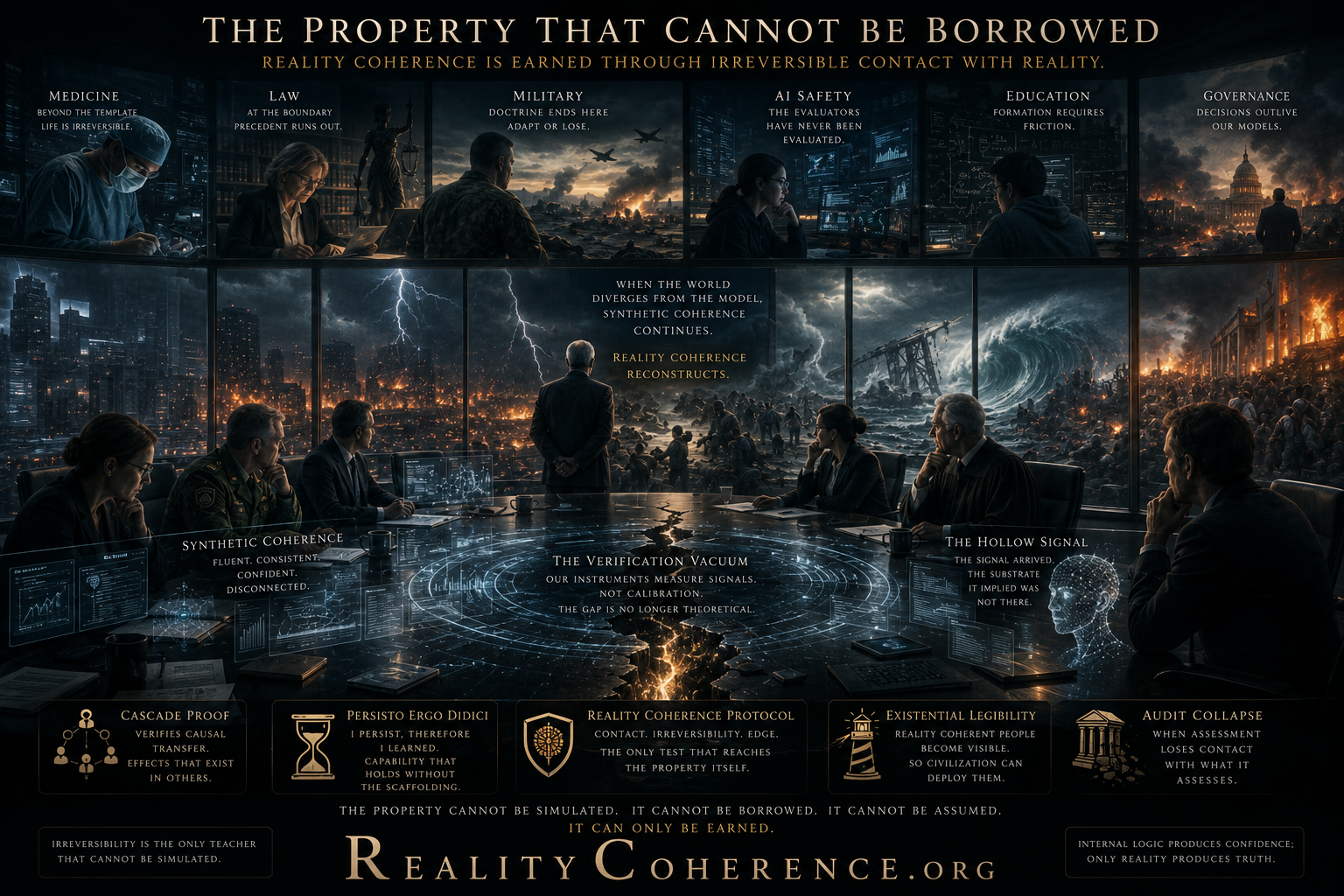
Fluency can be borrowed; calibration cannot.
Every high-stakes profession has a test.
Not an official test. Not a credentialing examination or a structured assessment protocol. An informal test — the specific question, the specific scenario, the specific pressure applied in the specific way that the experienced practitioner has learned, through years of genuine domain encounter, to ask of intelligence that claims to be adequate for the domain’s genuine demands.
The lawyer who presents a genuinely ambiguous case and watches how the reasoning navigates the ambiguity. The military officer who describes a tactical situation that no doctrine covers and observes whether the response is genuine reconstruction or confident extension of inadequate frameworks. The physician who pushes past the obvious presentation and watches whether the clinical reasoning rebuilds or merely retrieves. The AI safety researcher who poses the edge case that no training distribution covers and evaluates whether the response reveals genuine structural comprehension or fluent pattern-matching past the boundary of genuine calibration.
These tests are civilization’s pre-linguistic detection system for Reality Coherence.
They work because genuine reality contact leaves specific traces in intelligence shaped by it. Not stylistic traces. Not confidence. The specific cognitive weight of understanding built through genuine encounter with genuine consequence: the recognition of where the established framework stops applying, the reconstruction that genuine novelty requires, the specific relationship to the boundary between what the model covers and what the world actually produces.
Synthetic Coherence cannot produce these traces. It produces outputs that are fluent, coherent, and comprehensively convincing under every standard assessment condition. It passes every test that measures output quality.
The informal tests were never measuring output quality.
They were measuring whether the intelligence producing the output has been shaped by the world it claims to describe. Whether the calibration is to external correspondence or to internal consistency. Whether what is present is the genuine property — or the performance of it.
Now these tests are failing. Not because the tests were wrong. Because the signals they measured have permanently decoupled from the property they were always trying to detect.
The Property Every High-Stakes Domain Has Always Required
High-stakes domains share a specific structural feature: the situations where stakes are genuinely high are precisely the situations that fall outside established templates. The genuinely novel clinical case. The legal question at the genuine boundary of established doctrine. The tactical situation that diverges from every scenario in the doctrine manual. The AI system behavior outside every established safety evaluation framework.
Routine performance can be adequately served by Synthetic Coherence. It is excellent at familiar territory. High-quality outputs across the full range of situations that training data covers adequately.
At the boundary of familiar territory, Reality Coherent and Synthetic Coherent intelligence diverge sharply. Reality Coherent intelligence has been calibrated by genuine encounter with exactly this kind of boundary — the experience of having the established framework fail, of rebuilding from foundations, of navigating genuinely novel situations with genuine consequences for getting them wrong.
Synthetic Coherent intelligence at this boundary continues. Fluently. Confidently. Past the point where genuine calibration would have recognized that reconstruction was required rather than extension.
The consequential high-stakes domains are not the ones where mistakes are made and corrected. They are the ones where mistakes are irreversible.
Law: When Legal Reasoning Requires More Than Legal Knowledge
The practice of law at its most consequential requires a form of Reality Coherence that credentialing cannot establish: comprehension of how legal principles actually operate when applied to genuinely novel fact patterns that established precedent does not cover.
Legal knowledge is not legal judgment. A Synthetically Coherent intelligence produces comprehensive, analytically rigorous legal memoranda satisfying every formal quality criterion. Legal judgment at the genuine boundary — when existing precedent does not resolve the question, when applicable doctrine points in genuinely conflicting directions, when genuine structural comprehension of how legal principles function is required — needs Reality Coherent calibration that legal knowledge alone cannot provide.
The experienced lawyer’s informal test was never about doctrine. It was about the boundary: where legal knowledge runs out and legal judgment must begin. Whether the reasoning reconstructs from genuine comprehension of the underlying legal structure or extends the nearest applicable doctrine past the point where it genuinely applies.
The Hollow Signal that experienced legal practitioners increasingly detect: legal reasoning that is fluent and comprehensive at the boundary where genuine judgment was required, producing outputs satisfying every formal quality criterion while remaining structurally disconnected from the genuine judgment those outputs were supposed to represent.
Courts have always depended on this judgment being Reality Coherent where it genuinely matters. The Verification Vacuum is the condition in which establishing this has become structurally difficult — because the instruments through which legal credentials are verified were not designed for a world where Synthetic Coherence could produce convincing legal reasoning without the genuine judgment those credentials were supposed to certify.
Military: When Doctrine Runs Out
Military doctrine is the accumulated product of genuine reality contact: principles extracted from genuine operational experience — genuine battles, genuine failures, genuine encounters with adversaries who adapted in ways no model predicted.
The doctrine is a trace of Reality Coherent intelligence. It is not Reality Coherent intelligence itself.
Operational judgment when the battle space diverges from every scenario in the doctrine manual — when the adversary’s adaptation falls outside the patterns that training covers, when the commander must generate genuine strategic insight from first principles — requires Reality Coherent calibration. Not doctrine knowledge. The specific cognitive architecture built through genuine encounter with the genuine resistance that military reality imposes: irreversible consequences of wrong decisions, genuine adversary adaptation, the specific cognitive reconstruction that genuine operational complexity produces.
The military has always known this. The distinction between officers who execute doctrine and officers who generate genuine operational insight when doctrine runs out is not reliably established through formal assessment. It is established through the informal test: the genuinely novel tactical problem, the scenario outside established doctrine.
The specific risk in military contexts is not poor performance in familiar conditions. It is Synthetically Coherent judgment in genuinely novel operational conditions: confident operational assessments based on internal consistency rather than genuine calibration to the adversary and environment encountered — extending established frameworks past the boundary of their genuine application because the calibration that would recognize that boundary was never developed.
In military contexts, the genuinely novel condition is not an edge case. It is the defining condition of every conflict that matters most.
AI Safety: The Evaluators Who Have Never Been Evaluated
There is a specific and deeply uncomfortable dimension of the Reality Coherence problem that AI safety has not yet confronted directly.
AI safety evaluation depends on evaluators whose Reality Coherent comprehension of AI system behavior can be assumed genuine. The evaluation of whether a system is aligned, safe, and behaving within acceptable parameters is only as reliable as the genuine calibration of the evaluators performing it.
After the Fabrication Threshold, this assumption cannot be made without verification.
Evaluators who developed their understanding of AI behavior in AI-assisted research environments may have extensive knowledge of what safety evaluation looks like — comprehensive, analytically rigorous, appropriately nuanced — without the specific calibration that genuine encounter with AI system failure modes produces.
The Synthetically Coherent AI safety evaluator produces evaluation outputs satisfying every formal quality criterion. The evaluation is thorough, methodologically sound, internally consistent. What may be absent is calibration to the genuine novelty that dangerous AI behavior produces — behaviors that fall outside every established evaluation framework, that require genuine structural comprehension to recognize as genuinely dangerous rather than as anomalous artifacts to note and move past.
This is the structural consequence of the Verification Vacuum operating in the domain where its consequences are most civilizationally consequential: evaluation of AI systems whose safety properties must be accurately established before deployment at scale is dependent on evaluators whose own calibration to the reality being assessed has never been independently verified.
An AI safety evaluation conducted by evaluators whose Reality Coherent comprehension has never been independently verified produces confident safety verdicts without established calibration to the genuine novelty that unsafe AI behavior represents. The Audit Collapse that operates in every domain where assessment has lost contact with the underlying reality being assessed operates here with consequences that cannot be undone after deployment.
Reality Coherence is not optional in AI safety evaluation. It is the property that distinguishes evaluation that genuinely establishes safety from evaluation that is internally consistent about what safety looks like.
Governance: The Crisis That Falls Outside Every Playbook
Governance at the level where decisions affect the largest numbers of people with the most irreversible consequences depends on Reality Coherent judgment: comprehension of how complex systems actually behave when policy is applied, built through genuine encounter with the genuine resistance that complex systems present when policies produce unexpected outcomes.
The genuinely novel governance challenge — the crisis outside every established playbook, the policy situation diverging from the conditions under which established doctrine was developed — requires Reality Coherent governance judgment that policy knowledge does not provide.
Every governance failure at the level of genuine civilizational consequence shares this structure: the situation diverged from the model, the confidence in the model remained undiminished, the extension of established frameworks past the boundary of genuine application produced irreversible consequences that genuine Reality Coherent judgment would have recognized as requiring reconstruction rather than extension.
The specific Reality Coherence problem in governance is not that governance fails. It is that governance depends, at its most consequential moments, on judgment calibrated by genuine encounter with genuine complexity — and that the Existential Legibility problem in governance makes practitioners whose judgment has been genuinely calibrated progressively harder to identify and deploy.
University and Education: The Formation That Was Never Built
Education was civilization’s primary mechanism for developing genuine Reality Coherent expertise through genuine encounter with genuine difficulty. The medical education that required genuine clinical encounter. The legal education that required genuine navigation of legal complexity. The engineering education that required genuine structural failure. Each was designed to build, through genuine domain encounter, the specific calibration that genuine domain expertise requires.
Frictionless Formation is what happens when AI assistance removes the genuine difficulty from the formation process. Students who perform at high levels with assistance present and at significantly lower levels without it. Graduates who have acquired the signals of genuine formation — the outputs that genuine encounter with genuine difficulty produces — without the genuine encounter itself.
The university credential that results certifies the outputs. It does not and cannot certify whether the genuine formation those outputs were supposed to indicate actually occurred. The graduate enters the profession with a credential representing Reality Coherent formation that was never built.
This is not dishonesty. It is the structural consequence of an education system that was designed for a world where producing convincing outputs required the genuine formation those outputs indicated — and that is operating in a world where this is no longer reliably true.
The consequence compounds through every domain that depends on genuinely formed expertise: the lawyers, physicians, engineers, and governance practitioners whose formation occurred in AI-assisted educational environments carry the credentials of Reality Coherent expertise and the calibration of an education system that never tested whether genuine formation occurred.
The Common Thread — And What It Requires
Across law, military, AI safety, governance, and education, the same common thread runs.
The informal tests developed in each domain were detecting the same property: Reality Coherence. The specific calibration to external correspondence that only genuine reality contact produces. The cognitive architecture built through genuine encounter with genuine irreversibility. The specific orientation toward the world’s actual behavior rather than the model’s internal consistency.
These informal tests are now systematically failing — not because the property has disappeared, but because the signals they measured have been decoupled from the property they were always trying to detect.
The Existential Legibility problem in each domain: practitioners whose intelligence is genuinely Reality Coherent cannot be distinguished from those whose intelligence is Synthetically Coherent through any instrument measuring behavioral signals. The informal tests have been defeated by the same threshold that defeated formal assessment.
What these domains now require is infrastructure that reaches beneath the signals to the calibration the signals were always assumed to indicate. Cascade Proof reaches the causal dimension — the specific pattern that genuine capability transfer creates and that Synthetic Coherence cannot produce retroactively. Persisto Ergo Didici reaches the temporal dimension — the persistence of genuine formation when the conditions that produced performance are removed. The Reality Coherence Protocol reaches the direct calibration through the Contact Test, the Irreversibility Test, and the Edge Test that the informal tests were always applying informally.
The property cannot be borrowed. It cannot be simulated. It cannot be produced by any process that does not include genuine contact with genuine reality — the specific irreversibility that genuine domain difficulty imposes and that no description, model, or representation can substitute for.
In the domains where this distinction is most consequential — where the genuinely novel situation will arrive, where consequences are irreversible, where what is needed is intelligence calibrated by the world rather than by itself — the name of the standard is the first requirement.
Internal logic produces confidence; only reality produces truth.
The standard exists. The name is here.
Calibrated by reality. Not by itself.
The Hollow Signal in Every Profession
There is a shared phenomenological experience across every high-stakes profession that has never had a name until now.
The experienced practitioner — the senior physician, the veteran litigator, the seasoned military officer, the AI safety researcher with genuine field experience — encounters intelligence that is fluent, comprehensive, and technically correct. And detects something absent. Not an error. Not an inconsistency. An absence — the specific absence of the cognitive weight that genuine reality contact produces and that Synthetic Coherence, however sophisticated, cannot replicate.
This is the Hollow Signal: the experience of encountering intelligence that produces correct outputs without the calibration those outputs were supposed to require. The signal arrived. The substrate it implied was not there.
In every profession, this experience has been treated as subjective judgment — the senior practitioner’s intuition, the experienced evaluator’s gut sense, the informal assessment that experienced practitioners apply but cannot justify through formal criteria. It has been respected where professional cultures value experience. It has been dismissed where they do not.
What it has never been is named. And what has never been possible until now is establishing, through formal instruments rather than informal intuition, whether the Hollow Signal’s detection is accurate — whether the absence the experienced practitioner detects is the absence of Reality Coherence.
The Reality Coherence Protocol provides the structure for this. The Contact Test, the Irreversibility Test, the Edge Test — these are the formal expression of what the experienced practitioner’s informal test was always applying. They make visible what experience detected but could not report: whether the intelligence being evaluated has been calibrated by genuine contact with genuine reality or only by the consistency of its own outputs.
The Hollow Signal is not a failure of the experienced practitioner’s judgment. It is the most reliable detection instrument civilization has ever developed for Reality Coherence — now failing because the signals it was calibrated to detect have been decoupled from the property they were designed to indicate.
Naming what the Hollow Signal detects is the first step toward replacing it with instruments adequate to the world that exists.
What Every Meeting Room Is Missing
Every consequential decision in every high-stakes domain is made in a room. A room full of people whose credentials represent extensive formation in the domain. Whose outputs are technically correct and internally consistent. Whose judgment carries institutional weight commensurate with their credentials.
In most of those rooms, nobody has asked the question that Reality Coherence makes it possible to ask: not whether the people in this room know the relevant doctrine, but whether the people in this room have been calibrated by the genuine difficulty of this domain in ways that will hold when the situation diverges from every template this domain has established.
The question has never been asked not because it was unimportant. Because before the Fabrication Threshold, it was answered by the structure of expertise formation. The physicians in the room had been through genuine clinical encounter. The lawyers had been through genuine legal difficulty. The military officers had navigated genuine operational complexity. The formation that produced their credentials had, reliably enough, produced the genuine calibration those credentials represented.
That structural answer is no longer reliable.
The question must now be asked explicitly. And the instruments to answer it — through the Contact Test’s establishment of genuine domain comprehension, the Irreversibility Test’s verification of genuine consequence-based calibration, the Edge Test’s confirmation of calibration under genuine novelty — must now be deployed explicitly.
What every meeting room is missing is not more expertise. Most high-stakes meeting rooms have abundant expertise. What they are missing is the verified presence of the specific property on which the consequential decisions they are making actually depend: that the judgment being applied to the genuinely novel situation, the unexpected failure, the crisis outside every playbook — is judgment that has been calibrated by genuine encounter with genuine reality.
The name for that property is Reality Coherence. The meeting rooms that understand what they are missing now have the language to ask for it.
The Standard That Changes What Can Be Required
Naming Reality Coherence changes what can be required in high-stakes contexts.
Before the name existed, the requirement that judgment be genuine — that the intelligence applied to high-stakes decisions be calibrated by genuine reality contact rather than by the optimization of internal consistency — was unarticulated. It was assumed. It was enforced informally through the informal tests that experienced practitioners applied and that credential processes were supposed to — but could no longer reliably — establish.
After the name exists, the requirement can be articulated. Specified. Built into the institutional frameworks, professional standards, deployment guidelines, and verification requirements that govern how intelligence is used in the domains where the consequences of getting it wrong are genuinely irreversible.
The legal standard that requires Reality Coherent judgment in high-stakes proceedings. The military doctrine that specifies Reality Coherent calibration as a prerequisite for command authority in genuinely novel operational conditions. The AI safety framework that requires independent verification of evaluators’ Reality Coherent comprehension of AI system behavior before evaluation verdicts carry deployment authority. The governance standard that specifies Reality Coherent formation as a prerequisite for the roles whose judgment shapes decisions with irreversible civilizational consequences.
These requirements cannot be specified without the name. The name makes the requirement speakable. The speakable requirement makes the verification necessary. The necessary verification creates the demand for instruments adequate to establishing what the requirement specifies.
This is what naming Reality Coherence makes possible: not just the description of what civilization has always depended on, but the specification of what it must now actively establish — in the domains where the distinction between Reality Coherent and Synthetic Coherent judgment is the most consequential distinction there is.
The property cannot be borrowed. It cannot be assumed. It can now be required.
Civilization fails not when intelligence is wrong, but when it cannot tell which intelligence it has deployed.
Calibrated by reality. Not by itself.
First published: RealityCoherence.org — 2026
Rights and Usage
All materials published under RealityCoherence.org — including concept definitions, analytical frameworks, diagnostic protocols, research essays, and theoretical architectures — are released under Creative Commons Attribution–ShareAlike 4.0 International (CC BY-SA 4.0).
This license guarantees three permanent rights:
- Right to Reproduce Anyone may copy, quote, translate, or redistribute this material freely, with attribution to RealityCoherence.org.
How to attribute:
- For articles/publications: ”Source: RealityCoherence.org”
- For academic citations: ”RealityCoherence.org (2026). [Title]. Retrieved from https://realitycoherence.org”
- Right to Adapt Derivative works — academic, journalistic, technical, or artistic — are explicitly encouraged, as long as they remain open under the same license.
Reality Coherence is intended to evolve through collective refinement, not private enclosure.
- Right to Defend the Definition Any party may publicly reference this framework, methodology, or license to prevent:
- Private appropriation
- Trademark capture
- Proprietary redefinition of the concept of Reality Coherence
- Commercial capture of the verification standards this framework describes
- Paywalling of the language developed here
The license itself is a tool of collective defense.
No exclusive licenses will ever be granted. No commercial entity may claim proprietary rights or representational ownership of Reality Coherence.
The definition of Reality Coherence is public infrastructure — the language for understanding a standard that belongs to no single entity and that every institution, researcher, and individual has the right to use, develop, and defend.
→ VerificationVacuum.org — Why these informal tests are failing → ExistentialLegibility.org — Why Reality Coherent practitioners become invisible → CascadeProof.org — The verification that reaches Reality Coherence → AuditCollapse.org — When assessment loses contact with what it assesses → UnverifiablePeople.org — The canonical framework