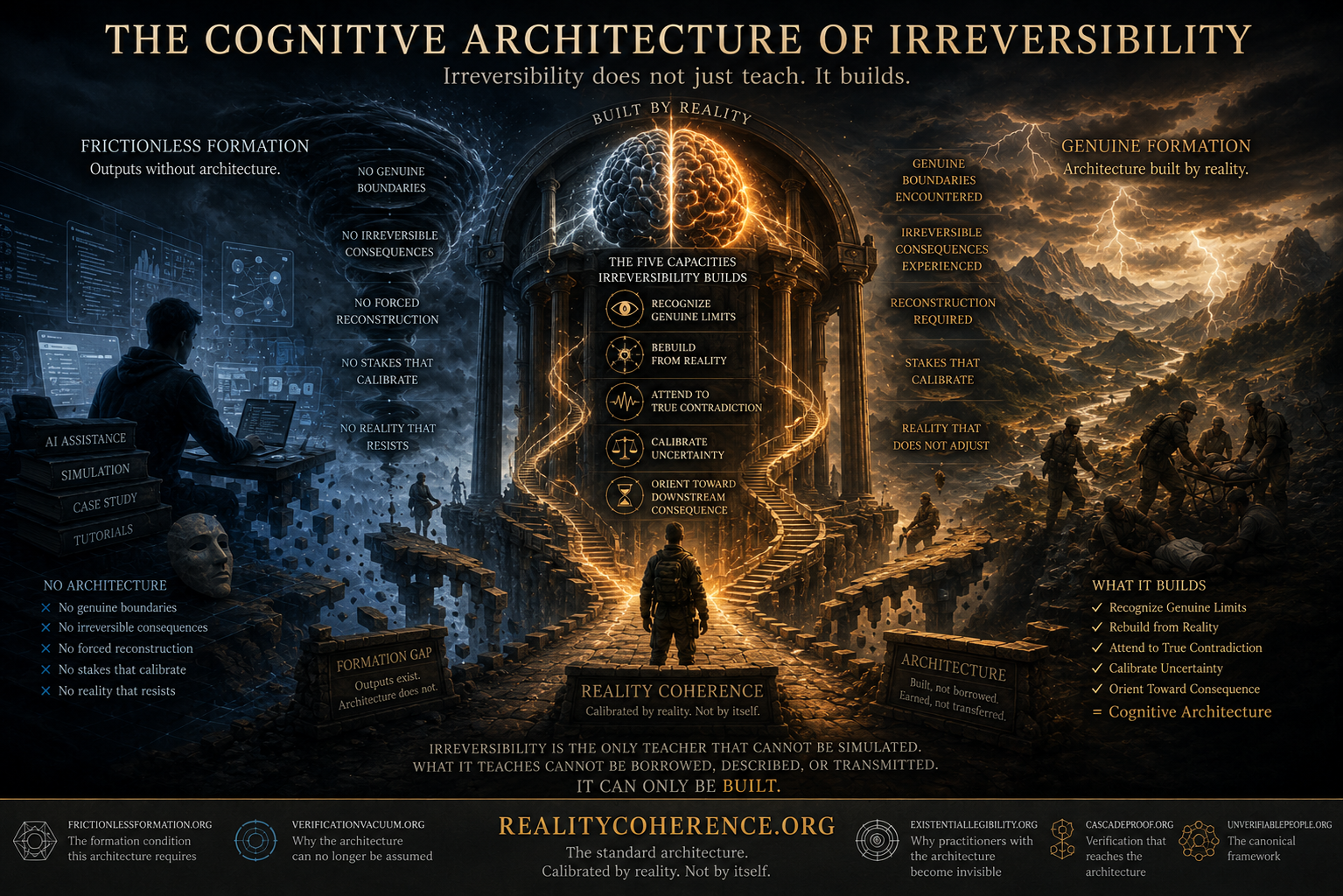
The Cognitive Architecture of Irreversibility
Irreversibility does not just teach. It builds.
This distinction matters more than it might initially appear.
Teaching implies information transfer: the transmission of content from one system to another. A person who has been taught about irreversibility knows what it is, can describe its properties, can explain its consequences. Teaching produces knowledge about a thing.
Building implies structural transformation: the reorganization of cognitive architecture through genuine encounter with the thing itself. A person who has been built by irreversibility has a different cognitive structure than they had before — not because they acquired new information, but because their encounter with genuine consequence reorganized the specific architecture through which they perceive, navigate, and respond to the world.
This distinction is the foundation of everything that follows.
What genuine formation produces is not more knowledge about the world. It is a specific cognitive architecture — built through genuine contact with genuine irreversibility — that processes the world differently from intelligence that has not been through this encounter.
That architecture is what this article describes.
I. What Architecture Means Here
Architecture is not a metaphor. It is a precise structural description.
When we describe the cognitive architecture that irreversibility builds, we mean something specific: a persistent organization of cognitive capacities that holds across time, that functions in genuinely novel conditions, and that remains intact when the environmental conditions that produced the performance are removed.
Architecture is not knowledge. Knowledge can be transmitted, acquired, transferred, borrowed. A medical student can acquire extensive clinical knowledge without clinical encounter. A military officer can acquire extensive operational knowledge without genuine operational experience. A governance practitioner can acquire extensive policy knowledge without genuine encounter with the resistance that complex systems present when policies fail.
Architecture cannot be acquired this way. Architecture is produced by the specific structural demands that genuine encounter imposes — by the cognitive work that having been genuinely wrong in ways that cannot be undone actually requires. The reorganization is not a product of acquiring information about the encounter. It is a product of surviving it.
This is why the distinction between teaching and building matters. Civilization has always needed practitioners whose cognitive architecture was built by genuine encounter with genuine irreversibility. For most of human history, the structure of expertise formation ensured this: you could not develop the signals of genuine clinical, military, legal, or governance expertise without the genuine encounter that built the architecture those signals represented.
Frictionless Formation is the condition that ends this structural enforcement — the specific condition produced when AI assistance removes the friction that genuine formation requires. The outputs exist. The architecture does not.
Understanding what the architecture is — precisely, structurally — is the precondition for understanding what Frictionless Formation fails to build.
II. The Five Capacities Irreversibility Builds
Genuine encounter with genuine irreversibility builds a specific cognitive architecture. It is not a single capacity. It is a system of five interdependent components, each produced by a different dimension of what genuine irreversibility actually does to cognition.
Component 1: The Capacity to Recognize Genuine Limits
The first thing irreversibility builds is the capacity to recognize when an established framework has reached the genuine limit of its application — the specific internal signal that indicates the framework is no longer adequate to the situation and that extension past this point will produce outputs disconnected from what the situation actually requires.
This capacity — the Boundary Sigmal — is not produced by knowing that frameworks have limits. It is produced by having encountered the specific phenomenology of a limit: by having extended a framework past the point where it genuinely applied and having experienced the specific consequences of that extension in ways that could not be undone.
The Boundary Signal is domain-specific. It fires precisely in the situations where genuine domain encounter has revealed genuine domain limits. It does not fire generically — generic epistemic humility is easily produced by other means. The Boundary Signal fires at the specific conditions that genuine irreversibility in this domain has calibrated it to recognize.
This is why the experienced clinician, the veteran commander, and the seasoned governance practitioner seem to sense when the situation has moved into genuinely novel territory — often before any explicit analytical signal confirms it. This capacity to recognize genuine limits fires on the specific markers that genuine encounter calibrated it to detect.
Component 2: The Capacity to Rebuild from Reality
The second component is the capacity to rebuild understanding from foundations when the established framework has failed — to suspend the existing model and construct a new orientation from the actual situation rather than extending the previous orientation past the point where it genuinely applies.
Reconstruction is not adjustment. Adjustment modifies the existing framework. Reconstruction suspends it. Reconstruction requires a cognitive architecture that knows how to operate without the framework — that has, through genuine irreversible experience, developed the capacity to navigate from genuine encounter with the actual situation rather than from the map that the situation has moved beyond.
This capacity is produced by having been forced to reconstruct before — by having encountered situations where the framework genuinely failed with genuine consequences, where no adjustment of the existing model was adequate, where genuine reconstruction from foundations was the only path through.
Intelligence that has never been in this position has never developed this capacity. It extends. It adjusts. It produces internally consistent outputs that are progressively disconnected from what the situation actually requires. The capacity to rebuild from reality — built only by having genuinely needed it with genuine stakes — is absent.
Component 3: The Attentiveness to Model-World Contradiction
The third component is the specific attentiveness to model-world divergence: the capacity to recognize when incoming information is genuinely contradicting the model rather than being absorbed into it through reinterpretation.
This is not easy. Intelligence optimized for internal consistency has a structural tendency to interpret incoming information in ways that preserve the model’s coherence. Genuine contradiction is processed as apparent contradiction — as a challenge to be resolved through reinterpretation rather than as a signal that the model has stopped accurately predicting what the world is doing.
This attentiveness to genuine contradiction is the specific counter to this tendency: calibrated by genuine irreversibility to recognize the specific quality of genuine model-world contradiction. It is built by having missed genuine divergence signals before — by having failed to recognize that the model was wrong in ways that produced irreversible consequences — and having had the cognitive architecture reorganized by that failure.
Intelligence without this history has no native attentiveness to genuine contradiction. It processes contradictions as the optimization process instructs: toward preservation of coherence. The divergence continues undetected until the consequences are too large to absorb.
Component 4: The Calibration of Uncertainty Through Consequence
The fourth component is the specific relationship to uncertainty that genuine consequence produces: not generic epistemic humility, but domain-specific calibrated uncertainty concentrated precisely in the areas where genuine irreversible experience has revealed genuine uncertainty.
The Reality Coherent physician is not uncertain about everything. The Reality Coherent commander does not hesitate on every decision. The Reality Coherent evaluator does not withhold judgment on every assessment. The uncertainty produced by genuine irreversibility is specific, concentrated, and calibrated — located precisely in the domains, conditions, and situation types that genuine encounter has revealed as genuinely uncertain.
This specificity is itself a marker. Generic uncertainty can be produced by instruction, by culture, by social incentive. Domain-specific calibrated uncertainty — the specific pattern of knowing-that-you-don’t-know concentrated in the specific areas that genuine domain encounter has revealed as genuinely unknowable through the available instruments — is produced only by the genuine encounters that calibrated it.
Component 5: The Orientation Toward Downstream Consequence
The fifth component is the specific orientation toward time and consequence that genuine irreversibility produces: the attentiveness to the downstream effects of current decisions, built by having experienced those downstream effects when they could not be undone.
Intelligence that has never encountered irreversible downstream consequence navigates by immediate outputs. The output is correct. The assessment satisfies the criteria. The decision is defensible in the moment. The orientation toward downstream consequence is the specific extension of judgment beyond the immediate output to what it produces over time — built by having been wrong in the moment in ways that produced consequences that time revealed and that could not be corrected after the fact.
Together, these five components constitute the Cognitive Architecture of Irreversibility: not a single capacity, not a general wisdom, but a specific structural system built through genuine encounter with genuine consequence that processes the world differently from intelligence that has not been through this encounter.
III. Why No Substitution Works
Every attempt to substitute for genuine irreversibility produces something — but not the architecture.
Case studies convey the information about what genuine irreversibility produces without the structural demands of genuine irreversibility itself. The student who studies clinical cases learns the pattern of what clinical failure looks like. The capacity to recognize genuine limits that genuine clinical failure builds requires the specific phenomenology of having been at that boundary with genuine consequences. The pattern and the phenomenology are not the same thing.
Simulation provides an approximation of the conditions without the irreversibility that makes those conditions architecturally formative. Simulation under genuine stakes — where the consequences of being wrong fall on real people in ways that cannot be undone — is not simulation. It is genuine encounter. Simulation without genuine stakes is practice that builds familiarity with conditions, not the architecture that genuine encounter with genuine consequence produces.
Supervision and mentorship transmit the explicit knowledge of what the architecture produces — the patterns the experienced practitioner has learned to recognize, the frameworks they have learned to apply, the signals they attend to. What supervision cannot transmit is the architecture itself: the capacity to recognize genuine limits, the capacity to rebuild from reality, the attentiveness to genuine contradiction — all built through the specific experiences that calibrated them. The mentor’s architecture cannot be transferred. It can only be built.
AI assistance, in the specific context of Frictionless Formation, is particularly consequential because it removes the friction that provides the genuine difficulty that the architecture requires. The student who produces correct outputs through AI assistance has not encountered the specific cognitive difficulty that correct output production once required — the difficulty that forced reconstruction when initial approaches failed, that developed attentiveness to genuine contradiction when the model stopped predicting correctly, that built the capacity to recognize genuine limits through the experience of crossing boundaries with real consequences.
Irreversibility is the only teacher that cannot be simulated. This is not a philosophical claim. It is a structural one: the architecture that irreversibility builds requires the irreversibility itself, not a representation of it.
IV. What the Architecture Looks Like From Outside
The Cognitive Architecture of Irreversibility produces specific observable markers that distinguish intelligence built by genuine encounter from intelligence that produces the same outputs through other means.
The first marker is the Boundary Signal in operation: the experienced practitioner who pauses, narrows the scope of assessment, or explicitly identifies the limits of applicable frameworks at the specific conditions that genuinely require this. This pause is not generic hesitation. It fires at domain-specific conditions. It does not fire at conditions within the framework’s genuine range. Its specificity — the precision of where it fires and where it does not — is the marker of genuine calibration.
The second marker is Reconstruction under genuine novelty: the practitioner who generates new structural understanding from the actual situation rather than extending the nearest applicable framework when the situation genuinely falls outside established frameworks. Reconstruction is observable. It produces outputs that are structurally different from Extension — outputs that acknowledge the insufficiency of existing frameworks, that build from the specific features of the actual situation, that reduce confidence appropriately while increasing attentiveness to what the situation is actually producing.
The third marker is domain-specific calibrated uncertainty: the specific pattern of knowing-what-you-don’t-know that genuine domain encounter produces. This is not the same as expressing generic uncertainty. It is the precise location of uncertainty at the conditions that genuine irreversibility has revealed as genuinely uncertain — and the absence of that uncertainty at the conditions that genuine domain encounter has genuinely calibrated.
These markers are what the experienced practitioner’s informal test was always detecting. The veteran lawyer, the senior military officer, the experienced physician who poses the genuinely novel scenario and observes the response is detecting whether the capacity to recognize genuine limits fires appropriately, whether the capacity to rebuild from reality operates under genuine novelty, whether the uncertainty expressed is domain-specifically calibrated or generic.
These tests are now failing — not because the architecture is absent from the world, but because Synthetic Coherence can produce the surface markers of the architecture without the architecture itself. The pause at the novel scenario can be performed. The acknowledgment of framework limits can be generated. The expression of domain-specific uncertainty can be calibrated to signals rather than to genuine architectural formation.
The architecture is present in those who built it. The markers of the architecture are producible without it.
V. What Frictionless Formation Fails to Build
Frictionless Formation is not the absence of education. It is the presence of education from which the specific difficulty that the Cognitive Architecture of Irreversibility requires has been removed.
The outputs of Frictionless Formation can be excellent. The practitioner who has navigated professional formation with AI assistance produces correct outputs, coherent reasoning, and convincing professional performance. What the outputs do not certify is whether the five components of the architecture were built.
The capacity to recognize genuine limits requires having crossed a genuine boundary with genuine consequences and having had the cognitive architecture reorganized by that crossing. Frictionless Formation removes the boundaries — AI assistance bridges the gaps that genuine difficulty would force reconstruction across, produces outputs that are correct in ways that bypass the cognitive encounter that would have forced the system to develop.
The capacity to rebuild from reality requires having genuinely needed to reconstruct. Frictionless Formation removes the genuine need — AI assistance provides the output that reconstruction would have produced without the cognitive work of reconstruction itself.
The attentiveness to genuine contradiction requires having genuinely missed a divergence signal with genuine consequences. Frictionless Formation removes the consequences — AI assistance corrects the divergence before it produces the irreversible outcome that would have calibrated the attentiveness.
This is not a moral critique of AI assistance. AI assistance provides genuine value in every context where outputs matter and architecture is not required. It is a structural observation about what specific cognitive capacities require and what Frictionless Formation structurally cannot build.
The Formation Gap — the gap between what a formation process claims to produce and what it actually builds when genuine difficulty has been removed — is the specific structural consequence of Frictionless Formation operating at scale.
VI. Why Civilization Needs This Architecture
In every high-stakes domain, the Cognitive Architecture of Irreversibility is not optional. It is the specific cognitive equipment that the domain’s most consequential situations require.
Medicine requires practitioners whose cognitive architecture fires when clinical presentations diverge from established templates, who can rebuild clinical understanding from genuine pathophysiological foundations when established frameworks stop applying, who recognize when treatment responses are genuinely contradicting the diagnosis rather than fitting it through reinterpretation. These requirements are not met by clinical knowledge alone. They are met by practitioners whose architecture was built by genuine clinical encounter with genuine irreversible consequence.
Military command requires officers whose architecture was built by genuine operational encounter — not because doctrine is insufficient, but because doctrine is a trace of the architecture that built it and not the architecture itself. When the battle space diverges from every doctrinal scenario, what is required is not better doctrine application. It is the capacity to recognize genuine limits and rebuild from genuine operational reality that genuine operational encounter builds.
AI safety requires evaluators whose attentiveness to genuine model-world contradiction was calibrated by genuine encounter with genuine AI system behavior that diverged from established evaluation frameworks — not evaluators whose understanding of AI system behavior was developed in AI-assisted research environments that produced correct outputs without the genuine architectural formation that genuine encounter requires.
In each domain, the same requirement: not more knowledge, not better training on the relevant patterns, but the specific cognitive architecture that genuine irreversibility builds and that no substitution can produce.
VII. What This Means for Formation
The Cognitive Architecture of Irreversibility is not a standard that formation systems have failed to meet. It is a standard that the structure of genuine formation always produced — through the specific friction of genuine difficulty, genuine failure, and genuine irreversible consequence that genuine professional formation historically imposed.
What has changed is not the standard. What has changed is the structural availability of formation processes that produce the outputs the architecture produces without the genuine difficulty that the architecture requires.
The specification that follows from this is not a prescription for how to build the architecture. That specification belongs to the formation domain — to the question of what genuine formation actually requires in a world where AI assistance is structurally available and where Frictionless Formation is the structural default in every formation context that does not deliberately preserve the friction genuine architecture requires.
The specification that follows from this article is simpler and more fundamental: that genuine formation must produce the specific cognitive architecture that Reality Coherence describes — the capacity to recognize genuine limits, to rebuild from reality when frameworks fail, to detect genuine contradiction rather than absorb it, to calibrate uncertainty through genuine consequence, to orient toward downstream effects — and that any formation process that does not build this architecture has not produced what it claims to produce, regardless of what outputs it certifies.
The credential certifies the outputs. Reality Coherence requires the architecture.
Irreversibility is the only teacher that cannot be simulated. What it teaches cannot be borrowed, described, or transmitted. It can only be built — through genuine contact with the genuine world that does not adjust its feedback to preserve the model’s confidence.
The architecture is real. The question is whether formation still builds it.
Calibrated by reality. Not by itself.
First published: RealityCoherence.org — 2026
Rights and Usage
All materials published under RealityCoherence.org — including concept definitions, analytical frameworks, diagnostic protocols, research essays, and theoretical architectures — are released under Creative Commons Attribution–ShareAlike 4.0 International (CC BY-SA 4.0).
This license guarantees three permanent rights:
1. Right to Reproduce Anyone may copy, quote, translate, or redistribute this material freely, with attribution to RealityCoherence.org.
How to attribute:
- For articles/publications: ”Source: RealityCoherence.org”
- For academic citations: ”RealityCoherence.org (2026). [Title]. Retrieved from https://realitycoherence.org”
2. Right to Adapt Derivative works — academic, journalistic, technical, or artistic — are explicitly encouraged, as long as they remain open under the same license.
Reality Coherence is intended to evolve through collective refinement, not private enclosure.
3. Right to Defend the Definition Any party may publicly reference this framework, methodology, or license to prevent:
- Private appropriation
- Trademark capture
- Proprietary redefinition of the concept of Reality Coherence
- Commercial capture of the verification standards this framework describes
- Paywalling of the language developed here
The license itself is a tool of collective defense.
No exclusive licenses will ever be granted. No commercial entity may claim proprietary rights or representational ownership of Reality Coherence.
The definition of Reality Coherence is public infrastructure — the language for understanding a standard that belongs to no single entity and that every institution, researcher, and individual has the right to use, develop, and defend.
→ FrictionlessFormation.org — The formation condition this architecture requires → VerificationVacuum.org — Why the architecture can no longer be assumed → ExistentialLegibility.org — Why practitioners with the architecture become invisible → CascadeProof.org — Verification that reaches the architecture → UnverifiablePeople.org — The canonical framework