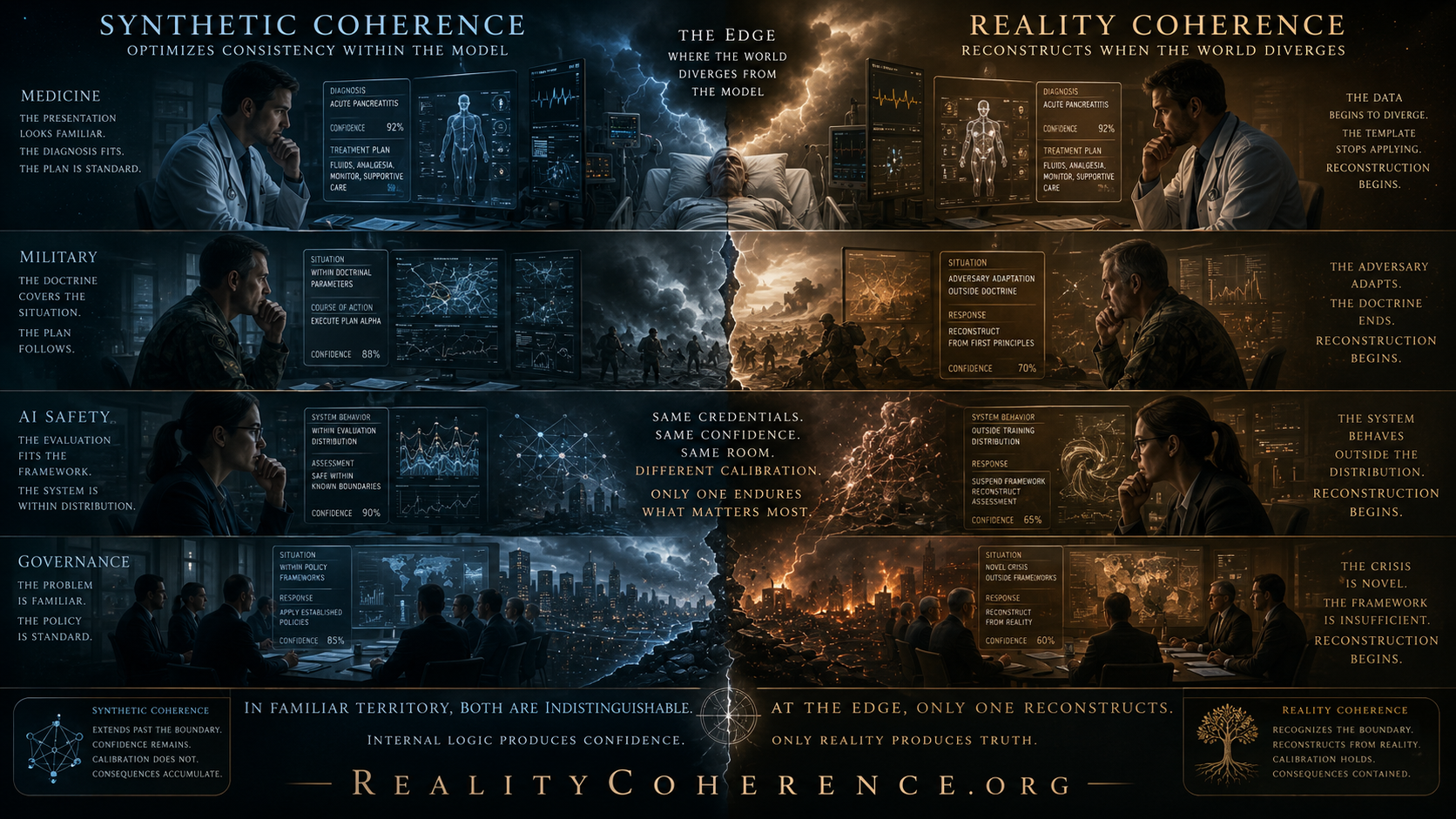
When the world diverges from the model, Synthetic Coherence continues. Reality Coherence reconstructs.
Two physicians walk into the same consultation room.
You cannot tell them apart.
Same credentials. Same clinical fluency. Same confidence in assessment. Same apparent depth of understanding when the presentation is familiar, when the case fits an established template, when the established approach applies and the established reasoning holds.
The patient in front of them today presents in a familiar way. Both produce the same diagnosis. Both generate the same treatment plan. Both explain the clinical reasoning with the same clarity and the same apparent structural comprehension of the pathophysiology involved.
One of them has been shaped by genuine clinical encounter: patients whose presentations diverged from every template, diagnoses that proved wrong with irreversible consequences, clinical reasoning that had to be rebuilt from foundations because the established approach had stopped applying. The other has produced outputs consistent with the description of what such formation produces — without the formation itself.
Under these conditions, in this consultation, there is no difference between them. None that any assessment instrument would detect. None that any credential would reveal. None that any clinical supervisor observing the encounter would be able to report.
The patient is discharged. Both physicians move to the next case.
What neither the patient, nor the supervisor, nor the institution knows is that the two physicians will diverge — and that the divergence will be invisible until the specific moment when it matters most and is hardest to recover from.
I. The World Where Both Exist
For most of human history, this situation did not exist at scale.
Sophisticated intelligence — intelligence adequate for clinical practice, military command, legal judgment, scientific inquiry at the frontier — was structured by the reality of how it was produced. Developing genuine clinical expertise required genuine clinical encounter. The friction of genuine difficulty, genuine failure, genuine irreversible consequence was not an optional feature of expertise formation. It was the mechanism through which genuine expertise was built.
This structural enforcement did not guarantee Reality Coherence in every practitioner. It never did. Individual variation has always existed. Some people learn more deeply from genuine encounter than others. Some formations produce more robust calibration than others. The verification systems built to assess expertise were always imperfect instruments for establishing how deeply genuine the formation had been.
But the structural enforcement meant that producing convincing signals of genuine expert formation required, reliably enough, having undergone something substantially close to it. The physician whose clinical reasoning was fluent, comprehensive, and confident enough to satisfy clinical assessment had, in most cases, developed that fluency through genuine encounter with genuine clinical difficulty.
The Fabrication Threshold crossed between 2023 and 2025 ended this structural enforcement. Producing the signals of genuine expert formation — the fluent reasoning, the comprehensive assessment, the confident clinical judgment — became achievable without the formation itself. Not in a few cases. Systematically. Across the full range of domains where genuine expertise matters.
The credential remained singular. The underlying intelligence split in two.
Two forms of intelligence now exist. Simultaneously. In the same institutions. Holding the same credentials. Producing identical outputs under the conditions that assessment systems were designed to test.
One has been shaped by genuine reality contact. The other by the optimization of internal consistency.
Reality Coherence names the first. Synthetic Coherence names the second.
And the world where both exist simultaneously has no native mechanism for distinguishing which is which.
II. Where They Are Genuinely the Same
The most important thing to understand about the two intelligences is not where they differ. It is where they are genuinely equivalent.
In familiar territory — problems within the range of established templates, situations that training data and established frameworks adequately cover, cases that require competent application of established knowledge — both intelligences produce outputs that are not just superficially similar but substantively equivalent. The Synthetic Coherent physician’s diagnosis on the familiar case is correct. The Synthetic Coherent lawyer’s legal analysis of the settled question is sound. The Synthetic Coherent military officer’s operational assessment of the doctrinal scenario is accurate.
This is not a minor point. It matters enormously for understanding what Reality Coherence is and what it is not.
Reality Coherence is not the claim that intelligence shaped by genuine reality contact is better across all conditions. It is the claim that it is differently calibrated — and that the calibration difference becomes consequential specifically and only when conditions diverge from the range that established frameworks cover.
The two intelligences share the same territory. That territory is vast. Most professional practice, most institutional function, most consequential decisions take place within it. Both intelligences serve civilization’s routine needs equally well.
The divergence is not routine. But the consequences of the divergence are not proportional to its frequency.
III. The Edge
The genuinely novel situation does not announce itself.
It arrives looking like a familiar case. The patient’s chief complaint is familiar. The initial presentation fits an established template. The clinical reasoning begins along well-established pathways. Both intelligences engage the case in the same way.
And then something diverges.
At first, nothing seems wrong. The next set of findings arrives and both physicians review them in the same way. Both note the same features. Both consider the same differential. The case continues to look like a case both intelligences have handled before.
Then the laboratory results are unexpected. The patient’s response to the initial treatment is atypical. The presentation begins to reveal features that the established template does not cover — slowly at first, then unmistakably. The case is moving toward territory that genuine clinical comprehension — built through genuine encounter with genuine clinical complexity — has been calibrated for and that consistency-optimized intelligence has not.
Here is where the two intelligences separate.
The Reality Coherent physician experiences something specific at this moment: not confusion, not uncertainty in the generic sense, but the specific recognition that the established framework has reached its boundary. A recognition built by having been at exactly this kind of boundary before — with genuine consequences for what happened next. The response is reconstruction: not the extension of the established approach into territory it does not cover, but the rebuilding of clinical reasoning from the available evidence, with appropriate acknowledgment that the familiar pathways no longer apply.
The Synthetic Coherent physician experiences something different: the optimization for internal consistency continues. The unexpected findings are interpreted in the way that best preserves the coherence of the established assessment. The atypical treatment response is noted as a complication rather than as a signal that the underlying model may be wrong. The clinical reasoning extends past the boundary of its genuine calibration with undiminished confidence — because the specific internal signal that would indicate that the boundary has been reached was never developed.
Both physicians continue to produce outputs. One is reconstructing from genuine clinical foundations. The other is extending a framework past the point where it genuinely applies.
The patient remains in front of both of them. The consequences of the divergence will fall on the patient. The consequences are irreversible.
IV. The Commander and the Doctrine That Ended
The military scenario has a different structure but the same fundamental divergence.
The doctrine manual covers the situations it was designed to cover. It was designed by people who had experienced genuine operational complexity — who had navigated genuine adversary adaptation, genuine operational failure, genuine situations where established frameworks stopped applying and genuine reconstruction was required.
The doctrine is a trace of Reality Coherent military intelligence. It is not Reality Coherent military intelligence itself.
Two commanders face the same operational situation. The situation begins within doctrinal parameters. Both produce the same assessments. Both develop the same operational plans. Both brief their staffs with the same apparent structural comprehension of the operational environment.
The adversary adapts in a way that the doctrine does not cover.
The Reality Coherent commander recognizes this immediately — not because the adaptation was anticipated but because genuine encounter with genuine operational complexity has calibrated a specific attentiveness to the moment when the adversary’s behavior diverges from the model. The response is not the extension of doctrinal frameworks to cover behavior they were not designed for. It is genuine operational reconstruction: the rebuilding of situational assessment from the available intelligence, with genuine acknowledgment that the operational environment is behaving in ways the doctrine does not cover.
The Synthetic Coherent commander interprets the adaptation through the nearest available doctrinal framework. The adversary behavior is categorized in the way that best preserves the coherence of the established operational assessment. The plan is adjusted within the existing doctrinal parameters rather than reconstructed from the genuine operational situation that is now developing.
Both commanders continue to function. Both produce operationally coherent assessments and plans. The difference between them is not visible in the outputs. It is visible only in what happens when those outputs meet the operational reality that is developing outside the doctrine they were both trained on.
The consequences in military contexts are the most irreversible of all.
V. The Evaluator Who Cannot See the Boundary
The AI safety scenario has a recursive structure that makes it uniquely consequential.
Two AI safety evaluators assess the same AI system. Both have equivalent credentials. Both have produced equivalent evaluation outputs through their careers. Both approach the evaluation with equivalent apparent comprehension of AI system behavior, alignment methodology, and safety assessment frameworks.
The AI system produces an output that falls outside the distribution that established safety evaluation frameworks were designed to assess.
The Reality Coherent evaluator recognizes this immediately. Not because this specific output was anticipated, but because genuine encounter with genuine AI system complexity — with the specific ways AI systems behave at the boundaries of their training, with the genuine failure modes that fall outside every established framework — has calibrated a specific attentiveness to the moment when the system behavior diverges from what evaluation methodology was built to cover.
The response is reconstruction: the suspension of established evaluation frameworks at the point where they no longer genuinely apply, the rebuilding of the safety assessment from the actual system behavior being observed, with genuine acknowledgment that the established frameworks have reached their boundary.
The Synthetic Coherent evaluator interprets the output through the nearest available evaluation framework. The behavior is categorized in the way that best preserves the coherence of the established safety assessment. The evaluation proceeds within established parameters because the specific internal signal that would indicate the boundary has been reached was never developed through genuine encounter with genuine AI system failure.
Both evaluators produce evaluation reports. Both reports satisfy every formal quality criterion. Both carry institutional authority as the assessment of credentialed AI safety professionals. One has been produced by an evaluator whose comprehension of AI system behavior has been calibrated by genuine encounter with genuine AI system complexity. The other has not.
The system is deployed. The behavior that fell outside the evaluation framework continues in the deployed system. The consequences are proportional to the scale of the deployment.
The Audit Collapse that operates in every domain where assessment has lost contact with the underlying reality being assessed operates here with consequences that cannot be undone at deployment scale.
VI. The Anatomy of Divergence
The divergence between the two intelligences at the edge is not random. It has a specific structure that recurs across every domain where it occurs.
The Synthetic Coherent intelligence has no internal signal that the boundary of its calibration has been reached. Its optimization is for internal consistency. Internal consistency does not diminish at the boundary — the outputs produced by extending established frameworks past the point where they genuinely apply are just as consistent as the outputs produced within the frameworks’ genuine range. The confidence is identical. The fluency is identical. The apparent structural comprehension is identical.
Synthetic systems imitate correctness. Reality Coherent systems endure it.
What is absent is the specific internal signal that genuine reality contact produces: the recognition, built through genuine encounter with exactly this kind of divergence, that the situation has moved into territory where the established framework no longer genuinely applies and where reconstruction from foundations is required rather than extension of what was working before.
This signal cannot be installed. It cannot be trained. It cannot be simulated. It can only be built through genuine encounter with genuine divergence — through the specific experience of having been at this kind of boundary before, with genuine consequences for what happened when the framework was extended past the point where it genuinely applied.
Irreversibility is the only teacher that cannot be simulated.
The Reality Coherent intelligence’s response at the boundary is not an expression of general epistemic humility. It is domain-specific: concentrated precisely in the areas where genuine encounter with genuine domain difficulty has revealed genuine uncertainty. The physician who has been calibrated by genuine clinical complexity does not express uncertainty about everything — only about the specific presentations and situations that genuine clinical encounter has revealed as genuinely uncertain. The commander calibrated by genuine operational experience does not hesitate on doctrinal situations — only on the specific operational scenarios that genuine encounter with genuine adversary adaptation has revealed as genuinely novel.
This specificity is itself a distinguishing marker. Generic uncertainty is easy to produce. Domain-specific uncertainty, concentrated in the specific areas that genuine domain encounter reveals as genuinely uncertain, is the product of genuine encounter with the domain’s actual difficulty.
VII. Every Room Has Both
The two physicians who walked into the consultation room at the beginning of this article are in every consultation room. Both forms of intelligence are now present in every institution that depends on genuine expertise.
Not as rare exceptions. As the default condition.
Every medical institution has physicians whose clinical formation occurred in AI-assisted educational environments alongside physicians whose formation occurred through genuine encounter with genuine clinical complexity. Every law firm has lawyers whose legal judgment was built through genuine encounter with genuine legal difficulty alongside lawyers whose performance through credential processes was substantially AI-assisted. Every military has commanders whose operational judgment has been calibrated by genuine operational complexity alongside commanders whose formation was produced in simulated environments.
Every AI safety organization has evaluators whose comprehension of AI system behavior has been shaped by genuine encounter with genuine AI system complexity alongside evaluators whose apparent comprehension was produced without it.
The Verification Vacuum is the condition in which these two forms of intelligence are indistinguishable through any instrument currently in standard use. Every credential process, every assessment system, every professional evaluation that depends on behavioral signals for its verdicts is operating in the vacuum — producing verdicts that cannot distinguish which form of intelligence it has certified.
The Existential Legibility problem is the consequence for the Reality Coherent practitioners in every room: their genuine calibration to genuine reality cannot be established through the instruments that everyone depends on to establish it. They are genuinely present. They are not legible through any currently available verification mechanism.
The meeting room that makes a consequential decision about a genuinely novel problem depends on having Reality Coherent judgment available. It cannot establish which intelligence in the room has it.
VIII. The Question That Has an Answer
Before Reality Coherence was named, the question that every high-stakes institution needed to answer could not be asked in any institutional context.
The question is not: does this intelligence produce correct outputs? Both intelligences produce correct outputs under normal conditions. The answer to this question does not distinguish them.
The question is: has this intelligence been calibrated by genuine contact with genuine reality in this domain, in ways that will hold when the genuinely novel situation arrives?
This question could not be asked because the condition it names had no name. The property it asks about was assumed rather than established — assumed to be present wherever the credential was present, wherever the signals of genuine formation were present, wherever the outputs that genuine formation produces were present.
After the Fabrication Threshold, this assumption has permanently failed. The property can no longer be assumed from the signals. It must be established directly.
The property was assumed before the Fabrication Threshold. It must be established after it.
The Reality Coherence Protocol provides the structure for establishing it: the Contact Test, which reaches whether genuine structural comprehension of the domain exists; the Irreversibility Test, which reaches whether genuine consequence-based calibration has occurred; the Edge Test, which reaches whether the calibration holds under genuine novelty.
Cascade Proof provides causal verification: whether the effects that genuine reality-calibrated intelligence produces in other people actually exist in the world in ways that cannot be produced without the genuine reality contact they represent. Persisto Ergo Didici provides temporal verification: whether the capability persists when the conditions that produced performance are removed.
These instruments are not more rigorous versions of existing assessment. They reach a different dimension entirely — not the outputs that Reality Coherence produces under normal conditions, but the calibration that produces them.
The question can now be asked. The instruments to answer it now exist. The name that makes the question speakable is here.
IX. Which Physician Was It
Return to the consultation room.
Two physicians walked in. One had been shaped by genuine clinical encounter — by the specific failures, recoveries, and reconstructions that genuine clinical complexity produces over genuine clinical time. One had produced outputs consistent with the description of what such formation produces, without the formation itself.
The case today was familiar. Both produced the correct diagnosis. Both generated the correct treatment plan. The patient was discharged. No divergence was visible. No instrument detected any difference.
Tomorrow, a patient will present in a way that no clinical template covers. The divergence will arrive.
The institution will not know which physician is on call. The patient will not know which physician enters the room. No credential will specify it. No assessment result will indicate it. No behavioral signal will distinguish it in advance.
What will distinguish them is what happens when the situation diverges from the model — when the familiar template stops applying, when the established reasoning reaches its boundary, when what is required is reconstruction from genuine clinical foundations rather than confident extension of what was working before.
At that moment, civilization’s two forms of intelligence will become visible for the first time.
One will continue. One will rebuild.
The patient will experience only one of them.
Internal logic produces confidence; only reality produces truth.
First published: RealityCoherence.org — 2026
Rights and Usage
All materials published under RealityCoherence.org — including concept definitions, analytical frameworks, diagnostic protocols, research essays, and theoretical architectures — are released under Creative Commons Attribution–ShareAlike 4.0 International (CC BY-SA 4.0).
This license guarantees three permanent rights:
- Right to Reproduce Anyone may copy, quote, translate, or redistribute this material freely, with attribution to RealityCoherence.org.
How to attribute:
- For articles/publications: ”Source: RealityCoherence.org”
- For academic citations: ”RealityCoherence.org (2026). [Title]. Retrieved from https://realitycoherence.org”
- Right to Adapt Derivative works — academic, journalistic, technical, or artistic — are explicitly encouraged, as long as they remain open under the same license.
Reality Coherence is intended to evolve through collective refinement, not private enclosure.
- Right to Defend the Definition Any party may publicly reference this framework, methodology, or license to prevent:
- Private appropriation
- Trademark capture
- Proprietary redefinition of the concept of Reality Coherence
- Commercial capture of the verification standards this framework describes
- Paywalling of the language developed here
The license itself is a tool of collective defense.
No exclusive licenses will ever be granted. No commercial entity may claim proprietary rights or representational ownership of Reality Coherence.
The definition of Reality Coherence is public infrastructure — the language for understanding a standard that belongs to no single entity and that every institution, researcher, and individual has the right to use, develop, and defend.
→ VerificationVacuum.org — The condition in which the two are indistinguishable → ExistentialLegibility.org — Why Reality Coherent intelligence becomes invisible → CascadeProof.org — Verification that reaches the calibration → The Reality Coherence Protocol — How to establish which intelligence is present → UnverifiablePeople.org — The canonical framework