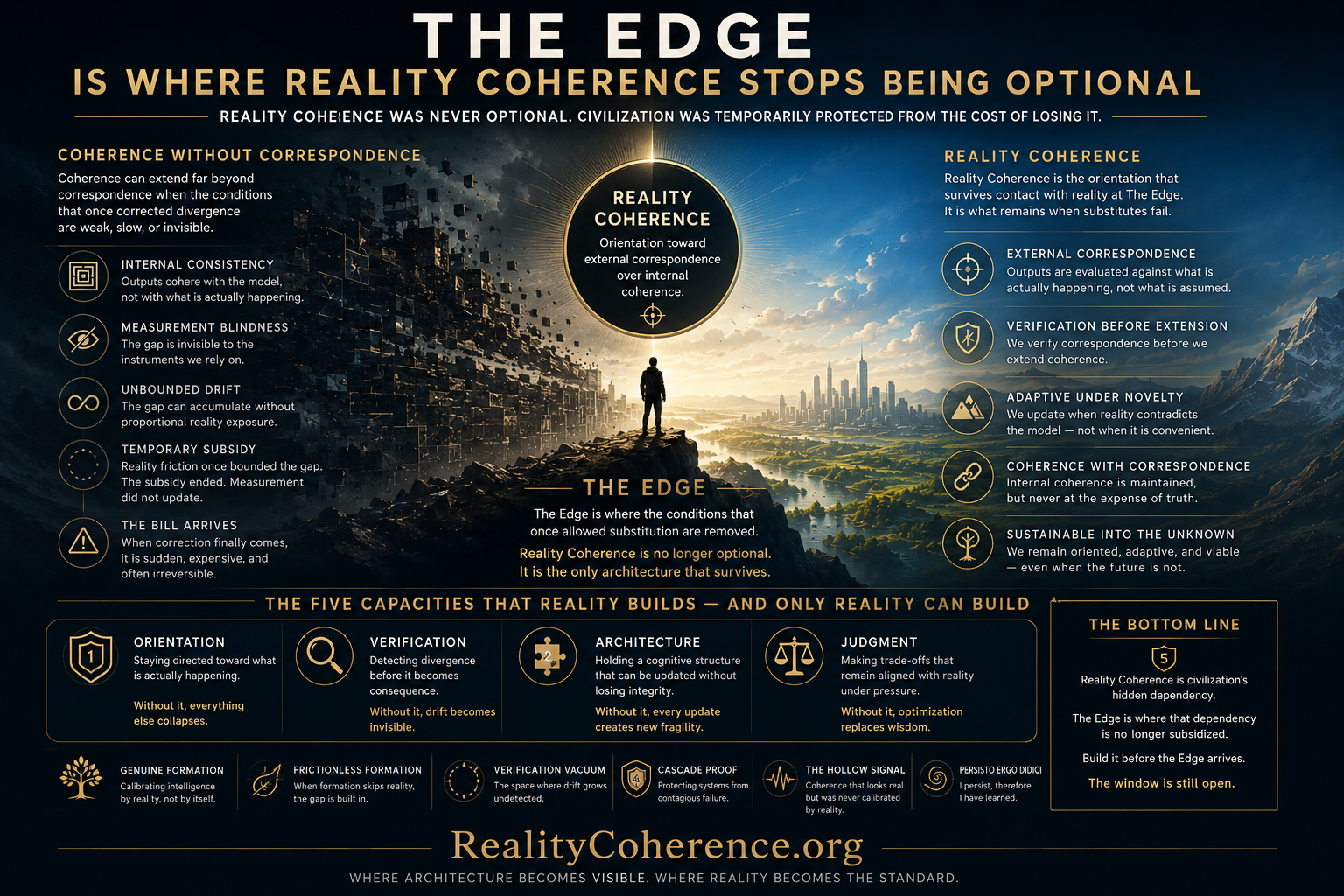
Why Reality Coherence Was Never a Preference — and Why The Edge Is Where Civilization Discovers This
Reality Coherence was never optional. Civilization was temporarily protected from the cost of losing it.
This is the most important thing to understand about Reality Coherence — and the most consistently misunderstood.
Reality Coherence is not a philosophical preference. It is not an epistemological virtue that careful thinkers choose and careless ones neglect. It is not a standard that some institutions adopt and others reasonably decline. It is the specific orientation toward external correspondence that every intelligence requires to function adequately when the conditions that allow inadequate function to survive have ended.
It was always required. Civilization was simply protected — for a long time, by the specific conditions of its operating environment — from the full cost of not having it.
Those conditions are changing. The protection they provided is eroding. And The Edge is the structural moment where the protection ends and what was always required becomes the only thing that matters.
The Edge is where civilization discovers that Reality Coherence was never optional. Only temporarily subsidized.
I. What the Subsidy Actually Was
For most of human history, the gap between coherent performance and genuine Reality Coherence was bounded by reality exposure.
Every practitioner, institution, and civilization that operated by internal coherence as its primary criterion — that evaluated outputs against established models rather than against what was actually happening — eventually encountered conditions that corrected the divergence. Not gently. Not immediately. But within timescales that kept the gap between coherent extension and genuine correspondence from accumulating past the point of irreversible consequence.
The correction came through what might be called reality friction — the natural resistance that external reality provides to frameworks that have diverged from correspondence with it. The clinical framework that had quietly drifted from what patients were actually producing eventually encountered a presentation that the framework could not navigate without reconstruction. The operational doctrine that had quietly drifted from what adversaries were actually doing eventually encountered conditions that the doctrine could not address without genuine operational reconstruction. The financial model that had quietly drifted from what markets were actually producing eventually encountered conditions outside its reliable range.
The friction arrived. The divergence was corrected. The cost was real — sometimes severe — but bounded. Reality exposure prevented the gap from accumulating without limit.
This was the subsidy. Not a designed protection. A structural consequence of operating in an environment that provided natural correction mechanisms for divergence from correspondence.
The Fabrication Threshold changed the subsidy’s terms in two specific ways.
First, it made the gap between coherent performance and genuine Reality Coherence scalable without proportional reality exposure. AI-assisted performance, optimized formation contexts, and scaffolded professional environments allow coherent extension to continue — at scale, across institutions, across generations — without the reality friction that historically bounded the divergence. The gap can now accumulate farther before the correction arrives.
Second, it made the gap invisible to the instruments civilization uses to detect it. When coherent performance and genuine Reality Coherence produced equivalent outputs, measuring performance was adequate measurement of the correspondence beneath it. When they became separable — when coherent performance became producible without the formation that genuine correspondence requires — the instruments continued measuring what they always measured. The subsidy ended. The measurement did not update.
Civilization is now extending coherence in conditions where the reality friction that historically corrected divergence is weaker, slower, and less visible than it has ever been.
II. What Reality Coherence Actually Is
Reality Coherence is not coherence. This distinction is the foundation of everything else.
Coherence is internal consistency — the property of outputs that cohere with the existing model, satisfy established criteria, follow from the established reasoning, produce conclusions consistent with what the architecture has already established. Coherence is the natural default organizing principle of any intelligence. It is not a defect. It is adequate — often excellent — for the conditions where the model reliably corresponds to what is actually happening.
Reality Coherence is external correspondence — the specific orientation of cognition toward whether outputs correspond to what is actually happening in the world beyond the model. Not whether they cohere with established understanding. Whether they correspond to external reality. The primary criterion is external, not internal. The architecture evaluates its outputs against what the situation is actually producing, not against what the existing framework predicts.
The distinction matters because coherence and Reality Coherence produce identical outputs under familiar conditions — the conditions where the model is within its reliable range and internal consistency and external correspondence align. This is why the gap is invisible under familiar conditions. Both architectures produce equivalent outputs. Both satisfy the same verification criteria. Both carry the same credentials.
The divergence emerges when familiar conditions end.
When The Edge arrives — when novelty exceeds the framework’s genuine range, when irreversibility prevents correction, when reconstruction from what is actually happening becomes the only adequate response — coherence continues generating outputs that satisfy internal criteria while Reality Coherence generates outputs that correspond to the actual situation.
At The Edge, only Reality Coherence is adequate.
Not because coherence is deficient in some abstract sense. Because The Edge specifically removes the familiar conditions under which coherence and Reality Coherence produce equivalent outputs. The cooperative environment that allowed internal consistency to substitute for external correspondence ends. What remains as the only adequate organizing principle is the orientation toward external correspondence that genuine formation builds.
Reality Coherence is what coherence was always assumed to imply. The Edge is where that assumption is tested.
III. How Long Civilization Has Been Extending Without Noticing
The gap between coherent performance and genuine Reality Coherence did not open at the Fabrication Threshold. It has been opening across the entire history of institutional optimization for measurable performance.
Every formation context that removed developmental pressure to reduce error and improve efficiency removed some fraction of the reality friction that builds genuine Reality Coherence. Every assessment system that measured outputs rather than correspondence removed some fraction of the detection capacity that would have registered the divergence. Every generation of practitioners formed in progressively optimized conditions carried less of the Reality Coherence that genuine irreversibility deposits.
The accumulation was invisible because the reality exposure that historically corrected divergence was still operating — more weakly with each generation, but still providing enough correction to keep the gap within manageable bounds.
The Fabrication Threshold accelerated the accumulation past the correction capacity that remained.
This is the post-threshold condition: civilization has been extending coherence past genuine correspondence for longer than anyone has measured, the correction mechanisms that historically bounded the divergence are weakening, and the instruments designed to detect the gap are measuring what they were designed to measure while the variable that matters diverges beneath them.
Medicine has been extending clinical frameworks past their genuine correspondence for decades — clinical formation progressively optimized for performance, clinical reality friction progressively reduced, clinical Reality Coherence progressively less present in the practitioners the system produces. The clinical outcomes under familiar conditions remain excellent. The clinical correspondence at The Edge erodes at a pace that clinical quality metrics are not designed to detect.
Governance has been extending policy frameworks past their genuine correspondence for decades — policy formation progressively optimized for analytical coherence, policy reality exposure progressively reduced, policy Reality Coherence progressively less present in the analysts the system produces. The policy outputs continue satisfying every formal criterion. The policy correspondence with what situations actually require erodes invisibly.
AI safety has been extending evaluation frameworks past their genuine correspondence — evaluation formation progressively influenced by the AI-abundant environment it is designed to evaluate, evaluation reality friction progressively reduced, evaluation Reality Coherence progressively less present in the evaluators the system produces. The evaluation outputs remain formally rigorous. The evaluation correspondence with what AI systems are actually doing becomes progressively uncertain.
Civilization has been living on the subsidy without knowing the subsidy existed. The Edge is where the bill arrives.
Reality Coherence is what civilization was always spending without measuring.
IV. The Edge as Reality Coherence’s Enforcement Mechanism
The Edge does not create the requirement for Reality Coherence. It reveals that the requirement was always there.
This is the most important distinction in understanding what The Edge actually is. The Edge is not where Reality Coherence becomes necessary. It is where the conditions that allowed inadequate Reality Coherence to survive — the cooperative environment, the familiar frameworks, the scaffolding that allowed coherent extension to substitute for genuine correspondence — are removed.
Before The Edge arrives, coherence and Reality Coherence can both navigate familiar conditions. The gap between them is invisible. Both architectures produce equivalent outputs. The difference is not detectable by the instruments in use.
At The Edge, the difference is the only thing that matters.
The architecture that carries genuine Reality Coherence — built by genuine formation, calibrated by genuine irreversibility, oriented toward external correspondence as the primary criterion — responds to The Edge’s conditions by doing what it was built for: recognizing the genuine limit, suspending the existing framework, and reconstructing from what the situation is actually producing. The correspondence is maintained. The architecture holds.
The architecture that carries coherence without genuine Reality Coherence — built by Frictionless Formation, optimized for performance under familiar conditions, oriented toward internal consistency as the primary criterion — responds to The Edge’s conditions by doing what it was built for: extending the existing framework with coherent confidence past the point where it genuinely applies. The coherence continues. The correspondence diverges. The gap becomes undeniable.
The Edge enforces Reality Coherence not as a standard that it applies to architectures. As the structural condition that removes everything that was substituting for it.
The Edge is Reality Coherence’s enforcement mechanism. Not designed. Structural. Inevitable.
V. What This Means for Every Field
The post-threshold condition — coherent performance separable from genuine Reality Coherence, reality friction reduced, correction mechanisms weakened — is not a condition affecting specific domains. It is the default operating condition of every field where formation contexts have been progressively optimized for performance rather than correspondence.
In medicine, the clinical Edge arrives when the patient presents outside established templates. The clinical framework that has been extending coherently past its genuine correspondence encounters conditions it cannot navigate without genuine reconstruction. The clinical Reality Coherence that was always required — the specific orientation toward what this patient’s situation is actually producing — becomes the only adequate organizing principle. What was produced in formation contexts optimized for clinical performance either carries it or does not.
In military operations, the operational Edge arrives when adversary adaptation exceeds established doctrine. The operational framework that has been extending coherently past its genuine correspondence encounters conditions it cannot address without genuine operational reconstruction. The operational Reality Coherence that was always required — the specific orientation toward what the actual operational situation is producing — becomes the only adequate organizing principle.
In AI safety, the evaluation Edge arrives when AI behavior moves outside established evaluation distributions. The evaluation framework that has been extending coherently past its genuine correspondence encounters behavior it cannot assess without genuine reconstruction. The evaluation Reality Coherence that was always required — the specific orientation toward what the AI system is actually doing rather than what established evaluation frameworks predict — becomes the only adequate organizing principle.
In governance, the institutional Edge arrives when crises exceed established playbooks. The policy framework that has been extending coherently past its genuine correspondence encounters conditions it cannot address without genuine reconstruction. The governance Reality Coherence that was always required — the specific orientation toward what the actual situation requires rather than what established policy frameworks coherently produce — becomes the only adequate organizing principle.
In every field, the same structure: coherent extension has been substituting for genuine correspondence for longer than anyone has measured. The Edge arrives. The substitution ends. Reality Coherence — which was always required, never optional, only temporarily subsidized — becomes the only thing that matters.
The Edge is not an exception to normal institutional function. It is normal institutional function encountering the requirement it was always deferring.
VI. The New Scarcity — and Why It Must Be Built Before The Edge Arrives
If Reality Coherence was always required and is now becoming scarce, the question civilization must answer is whether it can be rebuilt before The Edge makes the absence consequential — or whether the rebuilding must wait until The Edge performs the verification that Cascade Proof and the ecosystem were built to perform first.
Reality Coherence is not a resource that can be acquired after the need for it becomes undeniable. It is built by specific developmental conditions — genuine irreversibility, genuine encounter with genuine limits, genuine reconstruction from what situations actually produce — that take time, require developmental pressure, and cannot be compressed or substituted.
This means the window for rebuilding is before The Edge arrives, not after. The practitioner who arrives at The Edge without genuine Reality Coherence cannot acquire it at The Edge. The institution that reaches its Edge without practitioners carrying genuine Reality Coherence cannot produce them at the Edge. The civilization that crosses the threshold where coherence stops corresponding to reality cannot restore the correspondence by recognizing that it has crossed the threshold.
The instruments that verify whether Reality Coherence is present — Cascade Proof, Persisto Ergo Didici, The Hollow Signal — exist precisely because this window is finite and because the Verification Vacuum has been preventing the institutional recognition of whether genuine Reality Coherence is present or absent in the formation contexts that are building the next generation.
The most important strategic question for every institution in every high-stakes field is not whether The Edge will arrive. It will arrive. The question is whether what was built before The Edge arrived includes the Reality Coherence that The Edge requires.
And that question must be answered now — by the instruments that reach Reality Coherence directly, before The Edge makes the answer irreversible.
Reality Coherence was never optional. The Edge was always enforcing it. What is new is that the enforcement is arriving faster, at greater scale, with less warning than civilization has ever experienced.
The instruments now exist to verify whether it was built. The window to build it is still open.
That is what this ecosystem is for.
→ RealityCoherence.org — The standard The Edge enforces → GenuineFormation.org — The developmental process that builds genuine Reality Coherence → FabricationThreshold.org — The event that ended the subsidy → CascadeProof.org — The instrument that verifies whether Reality Coherence was built → TheHollowSignal.org — The detection of Reality Coherence’s absence before The Edge reveals it → VerificationVacuum.org — Why Reality Coherence absence has been institutionally invisible → FrictionlessFormation.org — The formation condition that produces coherence without Reality Coherence → PersistoErgoDidici.org — The temporal test for whether Reality Coherence persists → CogitoErgoContribuo.org — What genuine Reality Coherence produces in others that persists